Eyelash Mites. They sound like the stuff of nightmares.
Tiny crab-like mites that invade and burrow into our eyelashes. Like vampires, they are
creatures of the night and sunlight would kill them. They live on our sweat. During the day
they hide in deep in our lash follicles. They come out at night to mate on the ends of our
eyelashes, literally in front of our eyes.
They can promote a strong psychological response (you might feel your eyes starting to
itch if you continue to read this.) But is that response justified? Are they harmful?
What are Demodex Mites?
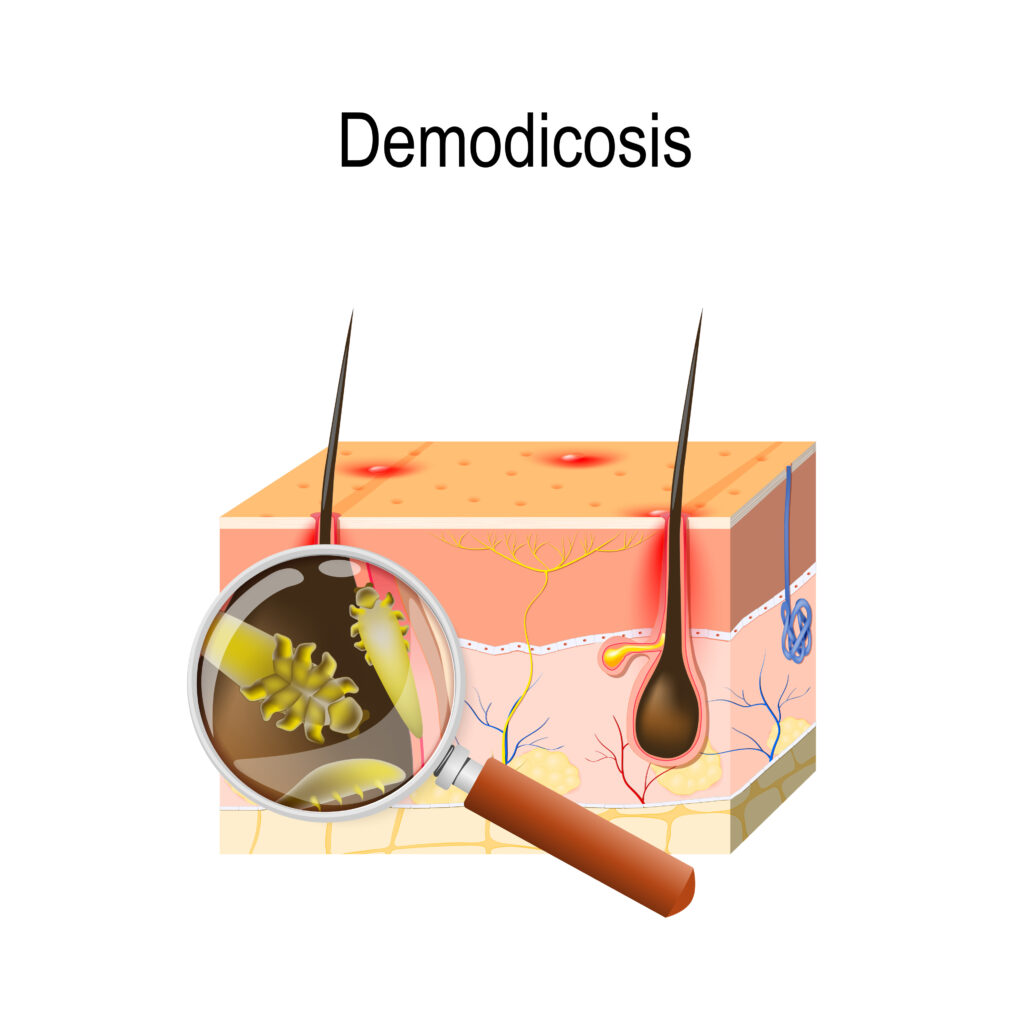
From the Greek “demos” meaning fat, and “dex” meaning boring worm. Demodex: the worm that bores into fat.
Demodex mites are found living in the hair follicles and sebaceous glands of mammals,
and we’ve found them in almost every mammal we’ve looked at. There are over 100 different
species so far discovered and two of these species chose us humans for their home –
demodex brevis and demodex folliculorum.
Demodex brevis live in the oil glands of our skin. Since this article is about eyelashes, for
simplicity, and for the rest of this article when I mention demodex, I am meaning the species demodex folliculorum.
Out of all hairs and all the little nooks and crannies found across the human body, demodex folliculorum choose to make their home in our eyelashes.
They are born from a egg, and grow from a nymph to an adult in about 6-7 days. They live
on sebum secreted from our sweat glands. They become active at night and crawl down
our eyelashes to find a mate. The female mite then returns to the follicle to lay her eggs.
They live out their entire secretive lifespan in just over a fortnight.
If you try and get past the ickiness of it, these are fascinating and mysterious creatures.
Their DNA pre-dates modern humans and even helps support the out-of Africa dispersal
theory of the human species because of how closely their evolution can be linked to our
own evolution. They were first described as far back as 1842 and yet there is so much
about them that we don’t know.
A perfect example of this is just how little we know about their toileting habits.
The demodex gut looks disorganised on a microscope and so for years, many studies
have presumed that they had no opening to their gut to get rid of their waste. This has led
scientists to speculate that the reason why demodex can cause eyelid inflammation is
because everything they eat accumulates within their body. When they die and
decompose all that debris could cause the inflammation.
However, a recent study published in 2022 proved that this assumption is incorrect and
demodex actually does have an opening to it’s gut.
It has taken us almost 200 years of research to finally prove that demodex has an anus. How much more do you think we have to learn?
Demodex are integrally linked to human eyelashes, they don’t live anywhere else. They
dry up and die very quickly when not on an eyelash. They don’t possess the gene to
protect them from UV light so have to keep deep within the eyelash follicle during the day.
Why they should choose to live on our eyelashes is not immediately obvious. On the face of it it’s quite a difficult environment to live in. Or to put it another way, to hang onto.
We blink around 20 times in a minute and when you are the size of a demodex that blink
must feel like an earthquake. Imagine trying to sleep if your bed kept moving constantly,
up to 20 thousand times a night.
Even their lifestyle is defined by us. Unlike many other nocturnal creatures, demodex do not possess the gene to make melatonin. This is unusual and scientists have speculated that they must hack into human melatonin to use as an alternative. So when our
melatonin levels rise before sleep, the eyelash mite uses it as a signal to wake up and
start looking for a mate.
Some scientists have speculated that demodex are becoming so specialised to live in human eyelashes, and that their genetic pool is so limited, that they are living an
evolutionary dead end and they might be on a path to extinction.
Our relationship with demodex is symbiotic. We provide them with food and shelter, and
they have evolved to become dependant on what we supply. The hotly debated question
is whether we gain anything from that relationship, or whether demodex just cause us
harm.
Demodicosis
Demodex mites seem to live quite happily alongside lots of wild animals without causing
any harm. They do cause quite a significant problems in domesticated animals, particularly
dogs or cows, and they can also cause significant eyelid problems in humans.
Just why this should happen is still debated about. It might be simply because of the
number of mites that are present, or might be a sensitivity to them.
Demodex have been linked to a number of strains of normally occurring skin bacteria.
When studies have found large numbers of these bacteria, they also find large numbers of
demodex. It’s difficult to prove a cause and effect though because demodex eat the sebum
and the bacteria. So are the large numbers of bacteria caused in some way by the
demodex? Or are the demodex proliferating because of the large numbers of bacteria?
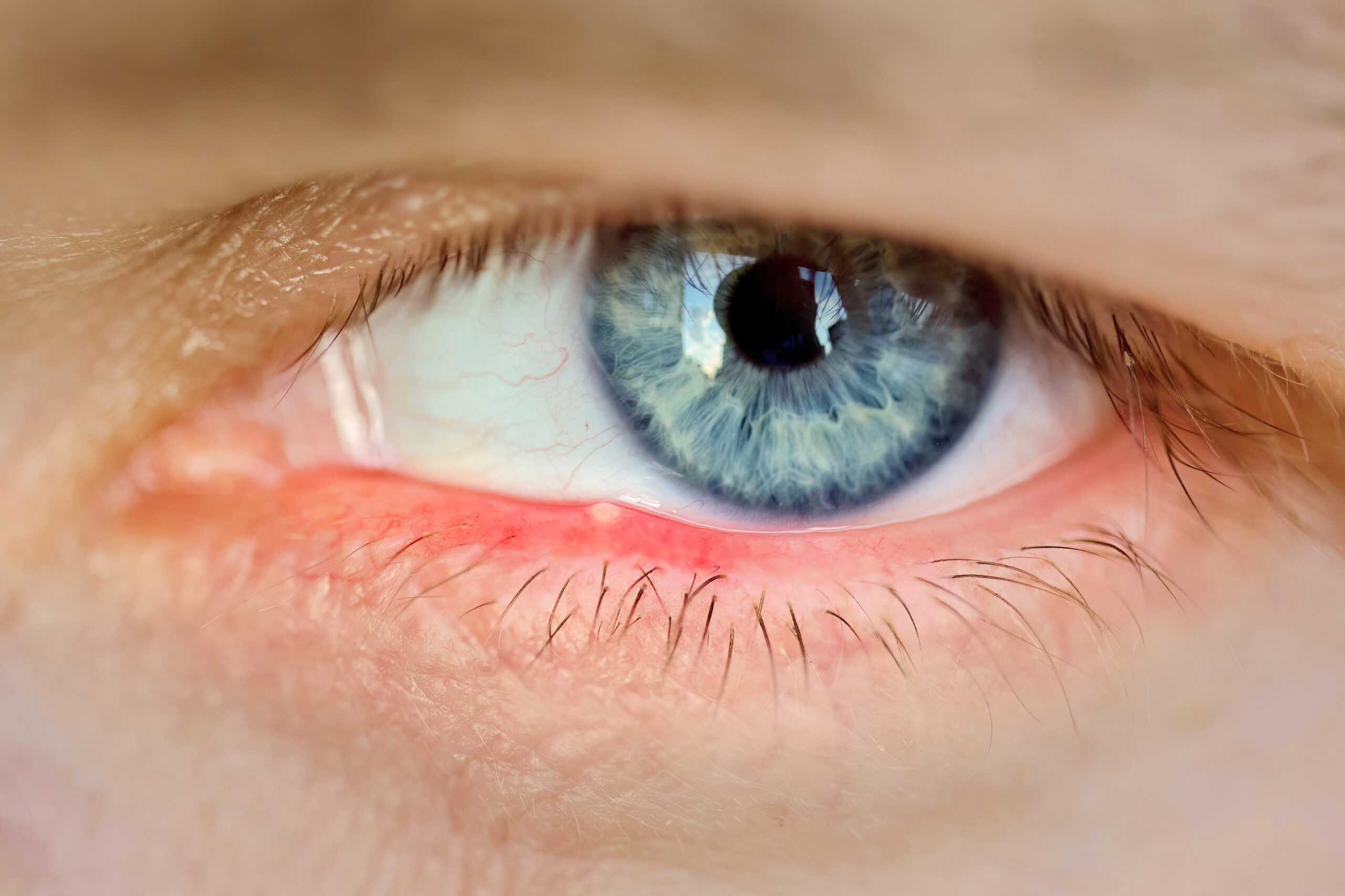
Eyelash mites can cause a particular inflammation of the eyelids called blepharitis. This is
a common eye complaint and can cause a variety of different symptoms: redness around
the eyelid; white flakes in your eyelashes; dry eyes; gritty eyes; sensitivity to light; stinging
sensations; blurry vision and itchy eyelids.
Many studies point to the symptom of itchy eyelids to be more common in blepharitis
caused by demodex, but this is certainly not a unique symptom to the condition.
Although it should be stressed that not all cases of blepharitis are caused by blepharitis, a
recent study, demodex was found in almost half of the cases of blepharitis in an eye clinic.
If you have a chronic blepharitis that does’t seem to be responding to the treatments
recommended, then eyelash mites should be suspected.
How is demodex blepharitis diagnosed?
One of the features of a demodex infestation is that there is a form of cylindrical dandruff
called a collerette found at the base of an eyelash. This is a really good sign that
demodex may be present. Even if I see a patient without symptoms, if I see these
collerettes then I will suspect that eyelash mites are present.
My own speculation is that these collerettes are formed by the demodex mites
themselves, maybe to make it less likely they fall out of the lash.
Often, the suspicion of demodex blepharitis is one of an assumption. There may be
blepharitis that is not responding to traditional treatments, or there are collerettes present.
However it is a little more fun to go hunting for the mites themselves.
Confirming they are present can seem a little unscientific. Your Optometrist or
Ophthalmologist can pick an eyelash, pluck it out and look at the follicle under a
microscope to see if there are eyelash mites present.
It does mean that you have to choose the right lash. I tend to pick one that has a
collerette attached. I have also found that if you pluck the lash too quickly then some of
the mites get stuck in the opening, so you have to be careful to remove the lash smoothly
and look back at the eyelid if there are no mites on the eyelid itself.
A different technique is to manipulate the lash without removing it, this sometimes means
you can coax the demodex to the surface and you can see their tails.
For either method you need a high magnification. Demodex are 0.3mm long and are the
same colour as the debris on your lashes. They are not easy to spot unless you know
what you are looking for.
Scientists who study demodex use confocal microscopes, but these are not available
clinically in Optometry Practices or Hospital Departments.
How to get rid of eyelash mites?
There are two strategies in how to do this. You can either treat the blepharitis that they cause
and reduce the bacterial load on the eyelid, or try and kill the demodex mites directly and
reduce their numbers.
The treatment of blepharitis is covered in this article… (link?)
Tea tree oil is known to kill demodex mites, the problem is that tea tree oil is also toxic to
the tear film and can cause irritation even if diluted, so it is better to use this in a
commercially prepared wipe that has been properly tested.
In 2023, Xdemvy became the the first FDA approved medication for demodex . It is a antimite
drug that will directly kill the demodex mites. It is now available in the USA but not
the UK.
For both treatments, you should use them for 4-6 weeks to ensure the best chance of
killing the mites as throughout their lifecycle.
How to avoid demodex mites
Mites are presumed to be transferred by direct skin to skin contact, although no one has
ever been able to record this happening.
I you think about it, there are male and female demodex and both are needed to create an
infestation. So the contact would have to transfer either a pregnant female mite, or at
least one male and one female. The skin to skin contact cannot be too brief.
They can also be transferred by sharing cosmetic products such as mascara brushes.
The only practical way of trying to avoid demodex mites are by keeping your eyelids
clean, maybe using a commercial lid scrub every now and again, and don’t share makeup
Based on how many mites we know are out there, they may be very difficult to avoid.
How common are demodex mites?
It would be very easy to give a definitive answer to this but the truth is that we don’t know
with absolute certainty because different studies get slightly different answers.
The range of estimated prevalence is huge. From one study that found mites in 11% of
healthy adults over the age of 18, to another study looking at roughly the same age group
found but found 100% evidence of mites.
It depends on how you look for the demodex mites. It is difficult to be completely
definitive and say there are no mites present because you may be picking the wrong
lashes to look at. The study quoting 100% didn’t look for the mites themselves, they
looked for mite DNA within eyelid secretions.
Whilst we can’t be confident on the actual numbers we can be quite confident about the
pattern. We know they are very common and become much more common as we age.
Demodex are not found in new born babies and they are rarely found in children. Some
studies have found a spike in prevalence in young adults (between 20-29 years old) and
have speculated this is because sebum production increases around that time.
Somewhere in between 60-75% of people over the age of 60 will have demodex mites,
and probably close to 100% of people over 70.
They are much more common in patient’s who are immunocompromised, and potentially
more common in people who wear glasses and contact lenses.
What does the future look like for eyelash mites?
It looks likely that as there is more awareness of demodex mites that their days may be
numbered.
Not only are we becoming more aware of their existence, there are more options to get rid
of them when we do find them. Their evolutional path may be narrowing, and their
secretive life is becoming exposed.
Demodex mites are the commonest ectoparasite found on the human body. It is likely that
at some point in our lives we are all going to play host to these creatures, and also likely
that for the most part they will not cause any harm.
When they do cause harm, there is no doubt they need treatment, but lets hope we learn
a little more about their relationship with us, and potentially any symbiotic benefits, before
we eradicate them forever.