Astigmatism is a common condition which is usually easily corrected with glasses, contacts lenses or, sometimes, surgery. Here we look at what it means if you have the condition, and what you can do about it.

Astigmatism is one of the less recognised parts of an optical prescription. Personally I think this is
because the term is a little more difficult to explain. It is less intuitive than being ‘short-sighted’ or
‘long-sighted,’ and it sounds like a terrible condition to be diagnosed with. I regularly get patients
worriedly asking me – “Have I got a stigma?”
The reality is that astigmatism is just another optical measure of the eye that can be generally
quite easily corrected with glasses, contacts lenses or surgery.
What is Astigmatism?
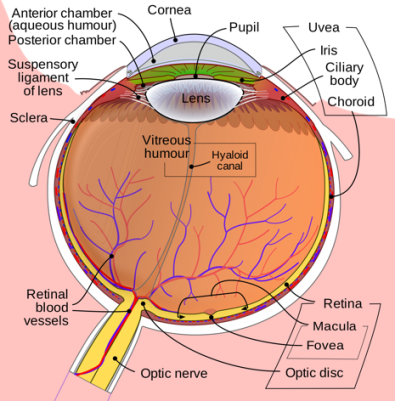
Our eyes have two optical lenses. There is a lens inside our eye that we imaginatively call, the
lens. However, the main optical component of our eye, making up around 2 thirds of the optical
power, is the clear front covering that we call the cornea.
For most of the us astigmatism only affects the cornea. It is rarer to have astigmatism affecting
the lens of your eye, and even rarer to affect the retina.
Astigmatism is the optical error when the surface of the cornea has two different shaped slopes,
and so creates two different points of focus
One of the analogies Optometrists like to use is to think about sports balls. If the curve of your
cornea is shaped like a football or basketball, it is perfectly spherical and there is no astigmatism.
If the curve is different in two different directions, like a rugby ball or an American football, this is
astigmatism.
What these two different slopes mean optically is that light entering the eye has a different focus
point for each curve. This creates a distortion in vision which is different to experience than being
just short or long sighted.
If you have a spherical, football shaped cornea, all the rays of light entering the eye converge to a
single point of focus. In an astigmatic, rugby ball cornea there is no single point of focus because
each curve focuses to a different point.
In English, we have the preposition a that means without.
In Greek, we have the word stigma, that can be translated as to point.
There is no single point of focus – without a point – Astigmatism.
You can thank the English scientist William Whewell for the slightly confusing use of terms. And
astigmatism can get complicated if you look deep enough into it because there are different types
of astigmatism and different terms to describe them. There is regular and irregular astigmatism;
oblique astigmatism; ‘with the rule’ astigmatism. All of these terms are forms of astigmatism and
all effect the front surface of the cornea.
How common is astigmatism?
People need glasses because there is an optical error in how their eyes focus light. The medical
term for this is a refractive error.
In a meta-survey completed in 2018 astigmatism was found to the most common refractive error
worldwide affecting approximately 40% of the population of the world.
Astigmatism is frequently combined with being either long, or short sighted and many optical
prescriptions will have an part astigmatic component to them.
As with other refractive errors, if the numbers are small and it is not causing any symptoms then
astigmatism doesn’t need to be corrected, and sometimes Optometrist’s won’t mention the
astigmatism because it is not the main component of the refractive error.
What are the symptoms of Astigmatism?
Astigmatism causes blurred or distorted vision. The distance you are viewing objects does not
matter and symptoms are the same when looking at close or distant objects.
It is a little different to experience than being short or long sighted. For example, if you are short
sighted and looking at the London Eye, it’s circular structure will look uniformly blurred. If you
have astigmatism, it will look slightly oval shaped and some parts of the it’s circle will be more
blurred than others.
Glare or halos around lights are also a common complaint, and studies looking at the quality of life
with astigmatism generally mention problems driving at night. This is because it is a symptom that
many patients with astigmatism will complain about.
How do I know if I have Astigmatism?
When you have an eye test, your Optometrist will give you a copy of your optical prescription.
These numbers describe the optical error of your eye and can be used to create lenses to correct
that error.
If you look at your optical prescription there are generally three numbers. The second and the
third number, the cyl and the axis describe your astigmatism. If there are no second and third
number then you don’t have astigmatism.
The cyl stands for cylinder. This describes the shape of the optical lens that is needed to correct
astigmatism. This number describes the power of your astigmatism and the higher this number is,
the worse your vision will be.
The axis describes the direction of the cylinder. If you imagine looking at a giant protractor. The
horizontal is 180 degrees and the vertical is 90 degrees. This number just describes a direction.
If you think back to the rugby ball analogy – If you wanted to recreate the way it looks, you would
need to describe both how sloped each curve is, and the direction of each slope. This is why you
need two numbers.
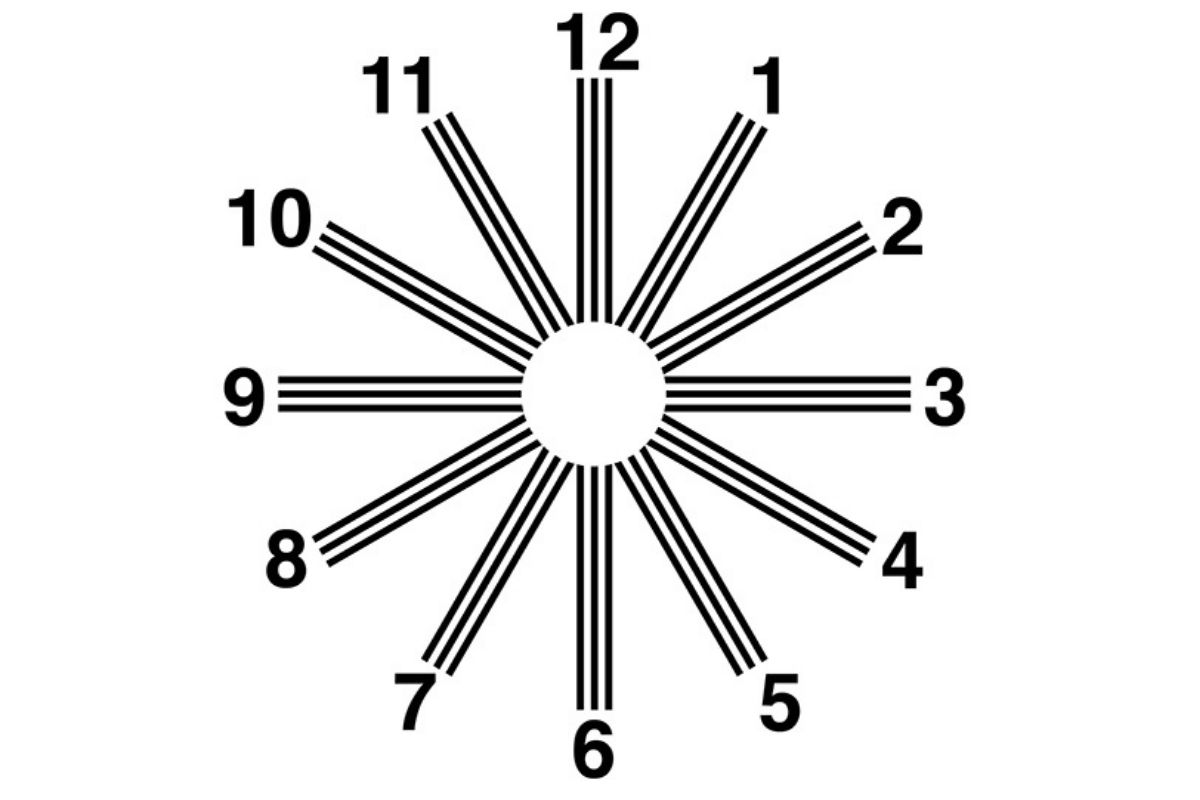
You could also try this quick self-test to see if you have any astigmatism. This is not foolproof, but
it may give you an idea whether you have any astigmatism.
Close one eye and look at the target above from a distance of c. 30cm.
Do any of the lines appear blacker or more in focus than the others?
If they do, this indicates you may have astigmatism.
Why does Astigmatism worsen?
When we are born our eyes are not fully developed and in particular the optics of our eyes are not
perfect. We are born with a lot of astigmatism. This corrects itself fairly quickly in the first few
months of life using nature’s autocorrect program called emmetropisation.
Generally speaking, all of the initial astigmatism should have corrected by 6 months of life and if a
child over the age of 1 year has significant astigmatism then it needs to be corrected to make sure
the visual system develops normally.
Once growth has finished and the cornea has settled, astigmatism generally does not change a
huge amount, and the general pattern of the astigmatism, the type and the axis, is fairly stable.
There are some eye diseases that change the shape of the cornea and so will also change the
astigmatism. The most common of these is keratoconus.
The cornea, and the astigmatism, can also change due to trauma or surgery.
All of these conditions can be picked up in a detailed eye examination.
How can Astigmatism be corrected?
Optically speaking, astigmatism is a little more complicated to correct than a spherical correction.
To correct astigmatism you need to hold that cylindrical lens in a stable position. The stronger the
astigmatism the more critical it is that all measurements are exact and correction is stable.
If it is corrected with glasses, there is a magnification effect that can be a little difficult to get used
to. For the first few days it is quite common to feel a little sea sick when moving your head
around. This effect fades quickly.
Contact lenses can be more complicated too. If using soft contact lenses a toric lens is needed
and it’s important that this lens does’t rotate too much on the eye, otherwise vision would not be
stable.
All that said, our technology now has much improved.
From the roman Emperor Neo supposedly looking through a concave emerald in glass stone, it
took just over a thousand years for the first pair of spherical glasses to be invented in around
1300.
You would have thought from that giant leap it would be a small step to correct astigmatism, but it
took another 500 years for the astronomer George Airy to invent the first cylindrical lens to correct
his own astigmatism in 1825.
In the modern era the correction of astigmatism is commonplace, and can generally be easily
corrected with glasses, contact lenses or surgery.